A fungal CRY-DASH photoreceptor mediates light-dependent and-independent regulation of growth and conidiation in Trichothecium roseum
07.04.2026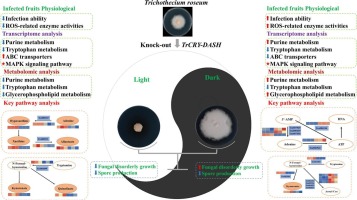
A fungal CRY-DASH photoreceptor mediates light-dependent and-independent regulation of growth and conidiation in Trichothecium roseum
Fuhai Zhang, Xiao Zhang, Yue Wang, Yuge He, Zongbo Qiu, Sujing Zhao, Shiqiang Gao, Mo Zhu (2026)
International Journal of Food Microbiology 460 (2026) 111972
Light is a key environmental cue shaping fungal growth and development. Among the several photoreceptor families, cryptochrome-DASH (CRY-DASH) proteins are conserved blue-light receptors best known for photolyase/photoreactivation activity, but emerging evidence suggests broader regulatory roles in fungi. Here, we demonstrate that the CRY-DASH photoreceptor acts as a key regulator governing fungal development in the postharvest pathogen Trichothecium roseum under white light and dark conditions. We generated TrCRY-DASH knockout (ΔTrCRY-DASH) and complementation (ΔTrCRY-DASH-C) strains and integrated phenotyping with transcriptomic, metabolomic, and molecular analyses. Loss of TrCRY-DASH caused contrasting light-dependent phenotypes: under white light condition, ΔTrCRY-DASH displayed growth arrest and reduced conidiation, whereas in darkness it exhibited excessive hyphal expansion with minimal conidiation, indicating a critical role in light-dependent growth regulation. Stress assays further showed strong light-dependent sensitivity to osmotic, cell-wall, and oxidative stress that was mitigated in darkness. Multi-omics revealed a far larger transcriptional reprogramming in darkness than in light, with enrichment of pathways linked to cell-wall metabolism, signaling, Reactive Oxygen Species (ROS) homeostasis, and secondary metabolism. TrCKI was predicted as a putative candidate for TrCRY-DASH interaction based solely on bioinformatic analysis, providing a hypothesis for future experimental exploration. Together, our data indicate that TrCRY-DASH is an important regulator that modulates dark-associated growth to maintain growth–conidiation balance and thereby influencing the virulence of T. roseum toward fruits.